Hannah Kiguiuk
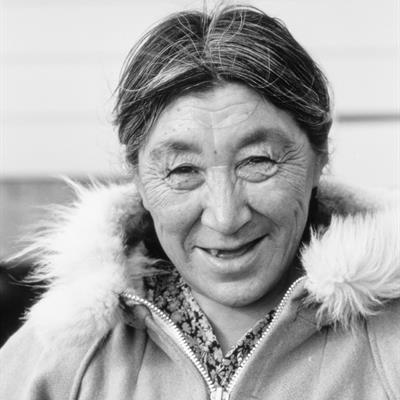
Artist Biography - (1931-1995)
Born near Garry Lake in the Central Canadian Arctic, Hannah Kigusiuq grew to adulthood living much the same as her Inuit ancestors had before her—residing in snow houses in the winter and skin tents in the summer. Married as a very young woman, Kigusiuq remembers travelling on the land and following the Arctic game animals in order to survive. She was in her mid-twenties in 1956 when her husband, Kuuk, and others from her camp were afflicted with tuberculosis—a condition that forced them to move to the settlement of Baker Lake, Northwest Territories, where he could receive medical treatment. During her husband’s subsequent two-year hospitalization in the South of Canada and as a means to supplement her meager income while she awaited his return to Baker Lake, Kigusiuq respnded to encouragement from the local crafts officer, Boris Kotelewitz, to try her hand at drawing.
Feeling clumsy at first because her only previous experience with drawing was to make ‘pictures’ on the ice window of her igloo as a child, Kigusiuq rapidly became engaged by this new activity and quickly proved herself to be a talented and inventive draftsperson with a distinctive personal style.
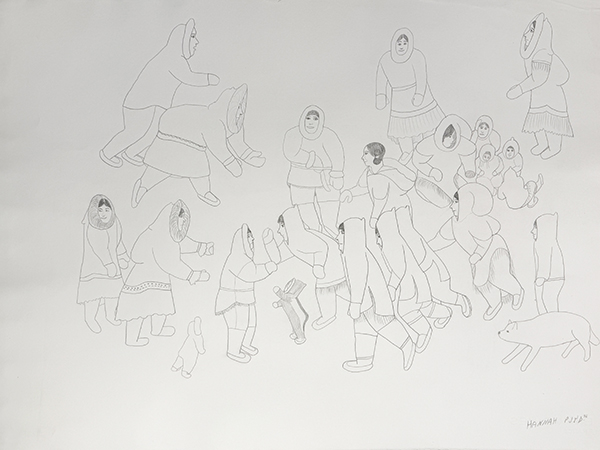
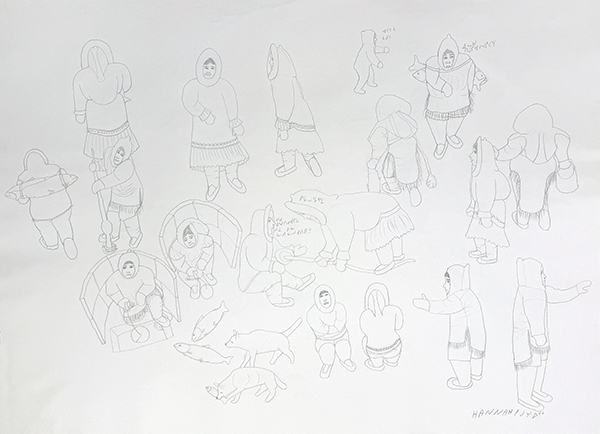
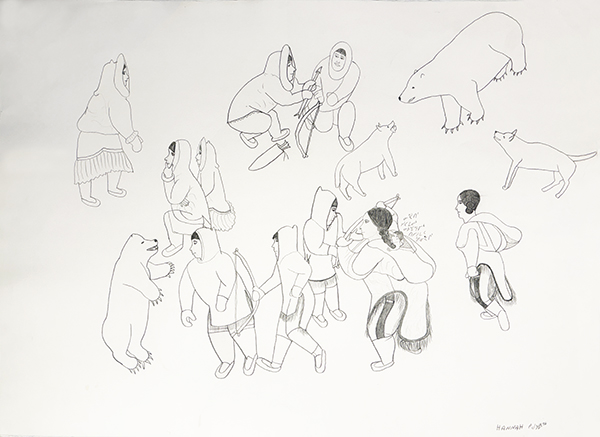
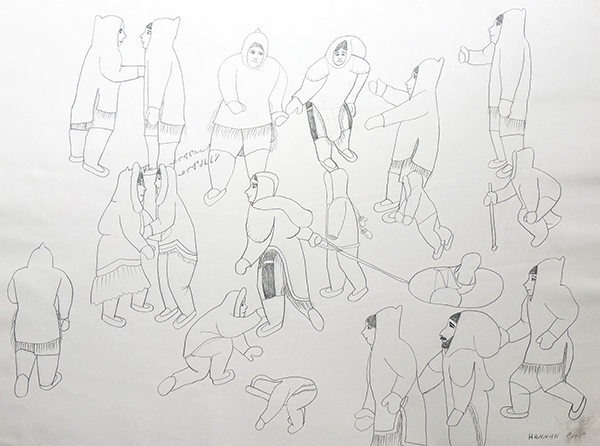
Kigusiuq draws inspiration for her art from her experience living on the land as a young woman, and she typically depicts communal activities from traditional Inuit lifestyle. Winter camp scenes, groups traveling on the land by foot or dogteam, and Inuit celebrating traditional drum dances are among her favored subjects, though Kigusiuq occasionally illustrates episodes from traditional Inuit mythology and from the Christian Bible as well. She is best known for her carefully controlled graphite pencil line drawings in which she situates large numbers of people and animals in complex relationships with one another frequently adding Inuktitut syllabic notations to clarify her intent or to present conversation among individuals. She rarely incoporates color, preferring instead the clarity of carefully-drawn line.”
--Marion E. Jackson in “North American Women Artists of the Twentieth Century: A Biographical Dictionary”, 1995
Public Collections:
Amon Carter Museum of Western Art, Fort Worth
Amway Environmental Foundation Collection, Ada
Anchorage Museum of History and Art, Anchorage
Art Gallery of Windsor, Windsor
Canadian Museum of History, Gatineau
CIBC Collection, Toronto
Confederation Centre of the Arts, Charlottetown
Edmonton Art Gallery, Edmonton
Inuit Cultural Institute, Rankin Inlet
Macdonald Stewart Art Centre, Guelph
McMichael Canadian Art Collection, Kleinburg
Museum of Anthropology, University of British Columbia, Vancouver
National Gallery of Canada, Ottawa
Prince of Wales Northern Heritage Centre, Yellowknife
University of Alberta, Edmonton
University of Lethbridge Art Gallery, Lethbridge
University of New Brunswick, Fredericton
Winnipeg Art Gallery, Winnipeg