Joane Cardinal-Schubert
(1942-2009) - Artist Biography
Joane Cardinal-Schubert was born in Red Deer, Alberta, on August 22, 1942. Her father, Joseph Trefly Cardinal, worked as a game warden for the Alberta Game Branch and was from the Kainai (or Blood Tribe) Nation. Her mother, Frances Magarete Rach, was of Métis decent and worked as a nurse. The couple had eight children: Douglas, Ron, Ken, Joane, Carole, Robert, Bryan, and David. Her brother, Douglas Cardinal, is one of Canada’s most influential contemporary Indigenous architects.
After moving around Red Deer a couple of times, the family settled on an acreage, that was also a mink farm, just north of the city. Joseph even moved a small house onto the property for his parents to live in. Joane’s new home would influence her future paintings. The lilies on the lake would be referenced in her paintings along with many star paintings. She would love to lie on the grass at night and watch the star constellations. The family also owned the Cardinal Motel, that was located next to the Bluebird Motel, on 3421-Gaetz Ave from 1954 to 1960.
She attended St. Joseph’s Convent in north Red Deer where she had to deal with the harsh Nuns. Assuming she had lice because of her heritage, Joane was scrubbed down with a long-handed broom, in a very hot shower. The Nuns were obviously not aware that Joane’s mother was a nurse and was very thorough about cleanliness.
The poor sanitary conditions of the school often made Joane sick, and her father finally decided to remove Joane from St. Joseph’s when she was in the fourth grade. She was transferred to a public school where she thrived. She loved to make her own clothes and read. By the time she was eleven, she had read all the books in the children’s section of the Red Deer Library – her favorite being Anne of Green Gables.
When she attended Lindsay Thurber Comprehensive High School, she met her future husband, Eckhart Schubert, who she called Mike (which he is still known as to this day). They would marry in 1965 and have two sons together – Christopher and Justin. Her father enrolled her in the Alberta College of Art, now called the Alberta University of the Arts, in 1962, but due to her shyness and “low imagination,” Joane only completed two years with below average grades. She later returned and studied from 1996-1997.
After her youngest son was two and a half, Joane enrolled in Fine Arts at the University of Alberta, then transferred to the University of Calgary. She graduated in 1977 with a BFA in printmaking and painting. Right after graduation, Joane became the assistant curator of the Nickle Arts Museum from 1979-1985, and also earned a certificate in arts management at the Banff Centre School of Management in 1983.
Joane’s art references several topics such as residential schools, mental/physical health, substance abuse, environmental degradation, and racism. Her work also touches on education and power, while integrating past and present Indigenous culture and motifs with western art materials. Her work has appeared in both solo and group exhibitions all over the world. This included Expo 1986 at the Canadian Embassy in Sweden and a trip to Japan and Korea in 1984 with the Alberta Society of Artists for the show, Sharing Visions.
Other achievements and acknowledgements included being the fourth woman inducted into the Royal Canadian Academy of the Arts (1985), receiving the Commemorative Medal of Canada (1993), honorary doctorate from the University of Calgary (2003), and the Queen’s Golden Jubilee Medal in 2005. The next year she was awarded an Alumni Award of Excellence from the Board of Governors of the Alberta College of Art and Design.
In 2007, Joane was awarded the National Aboriginal Achievement Foundation (now the Indspire Awards). Her writings have been published internationally in art magazines, catalogues, and books. University courses and art colleges across the country now study the works of Joane Cardinal-Schubert in Art History. Joane passed in 2009. A new high school in Calgary, AB, opened in 2018. In her honour it was named Joane Cardinal-Schubert High School (JCS).
Selected Exhibitions:
Beyond History at the Vancouver Art Gallery (1989)
INDIGENA: Perspectives of Indigenous Peoples on Five Hundred Years at the Canadian Museum of Civilization (1992)
Joane Cardinal-Schubert: Two Decades at the Muttart Public Art Gallery, 9 October – 7 November 1997
(Solo exhibit) Prairie Counter-plain - The Quilt Series, Masters Gallery Calgary Alberta 1997
(Solo exhibit) Prairie Mask, Derek Simpkins Tribal Arts Gallery, Calgary Alberta 1997
(Solo exhibit) Joane Cardinal-Schubert, Masters gallery. Calgary, Alberta 1994
(Solo exhibit) Joane Cardinal-Schubert RCA, Imperial Oil Gallery, Museum of the Regiments, Calgary Alberta 1994
(Solo exhibit) With Emily Carr (letters to Emily), Art Gallery of Greater Victoria, Victoria, BC 1994
(Solo exhibit) Joane Cardinal-Schubert, Keepers Counting-group, Gallery of Tribal Art, Vancouver BC1994
(Solo exhibit) Joane Cardinal-Schubert, Looking and Seeing, Gallery of Tribal Art, Vancouver, BC 1992
(Solo exhibit) Birch Bark Letters to Emily Carr, Vik Gallery, Edmonton Alberta 1991
(Solo exhibit) Joane Cardinal-Schubert, Inter-media Gallery, Minneapolis, Minnesota 1991
(Solo exhibit) Letters to Ottawa... Oka... Oka...Aiiee!, Ufindi Gallery, Ottawa, Ontario 1991
(Solo exhibit) Preservation of a Species: Cultural Currency, The Lesson, Articule Gallery. Montreal, Quebec 1990
(Solo exhibit) Preservation of a Species: Deconstructionists, Ottawa School of Art Gallery, Ottawa, Ontario 1990
(Solo exhibit) Joane Cardinal-Schubert, Meridian Gallery, San Francisco, California 1989
(Solo exhibit) Joane Cardinal-Schubert - Preservation of a Species, 1987-88 Gulf Canada Square Gallery, Calgary, Alberta 1988
(Solo exhibit) Preservation of a Species: Keeper, Muttart Public Gallery
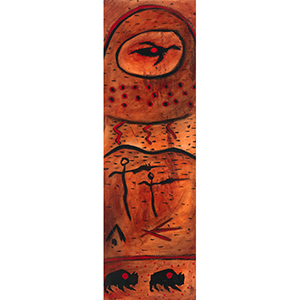
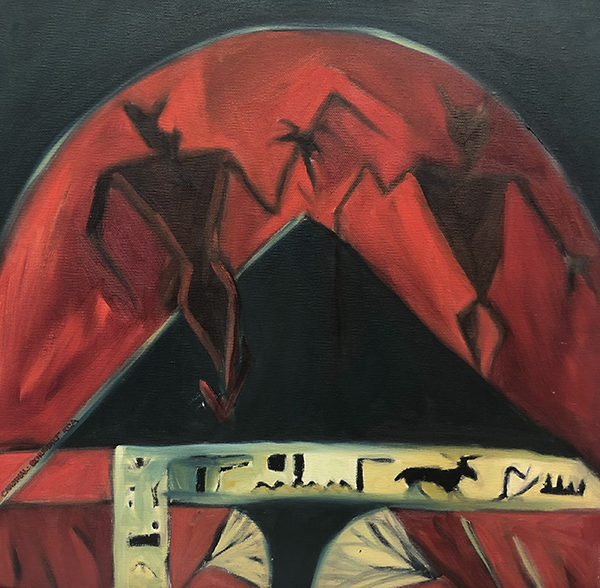
Technique: Cardinal-Schubert's paintings and installations tell of her personal experiences which she weaves with social and historical events. Visually her work depicts valiant Indigenous motifs while communicating about subjects that affect and impact her. She takes up and revisits continuously issues of colonialism and the destruction of the environment throughout her work which at times reflects a 'collective Indian experience' while at other times producing work which is also informed by trends in Western avant-garde and contemporary art. When asked about her experience as an Indigenous artist she writes: "I had a difficult time realizing I was categorized by my personal expressions. The categorization of Native Art was attached to my work and others' works by non-Native curators. Even though I had written the same exams in University and fulfilled all the requirements of a degree...when I got out of school my content which was largely about myself, who I was, my responses to the world etc. was labelled as Native Art and then political art - they seemed to go together. Later when Native Curators came on the scene, and called the work Native art - that was different. We were declaring who we were, not being told by others".